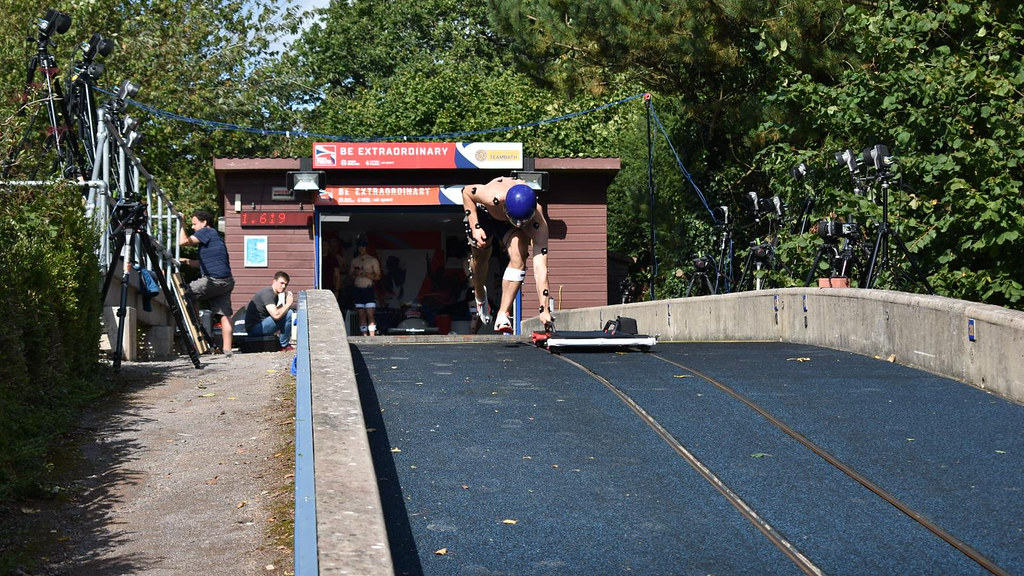
Nestled away by the fields beyond the University’s Sports Training Village stands a unique sight in the UK. Inconspicuously located behind a row of trees is our 140-metre outdoor push-start track – the only one of its type in the country – dedicated to helping Britain’s Skeleton athletes hone their starting technique away from the ice.
A unique sporting facility in the UK
It’s now 20 years since the push-start track, originally built after , opened back in 2002: the start of a long-term, partnership with the (BBSA), the governing body for British Skeleton which is now also based on campus alongside the , another of the University’s partners.
Going for gold
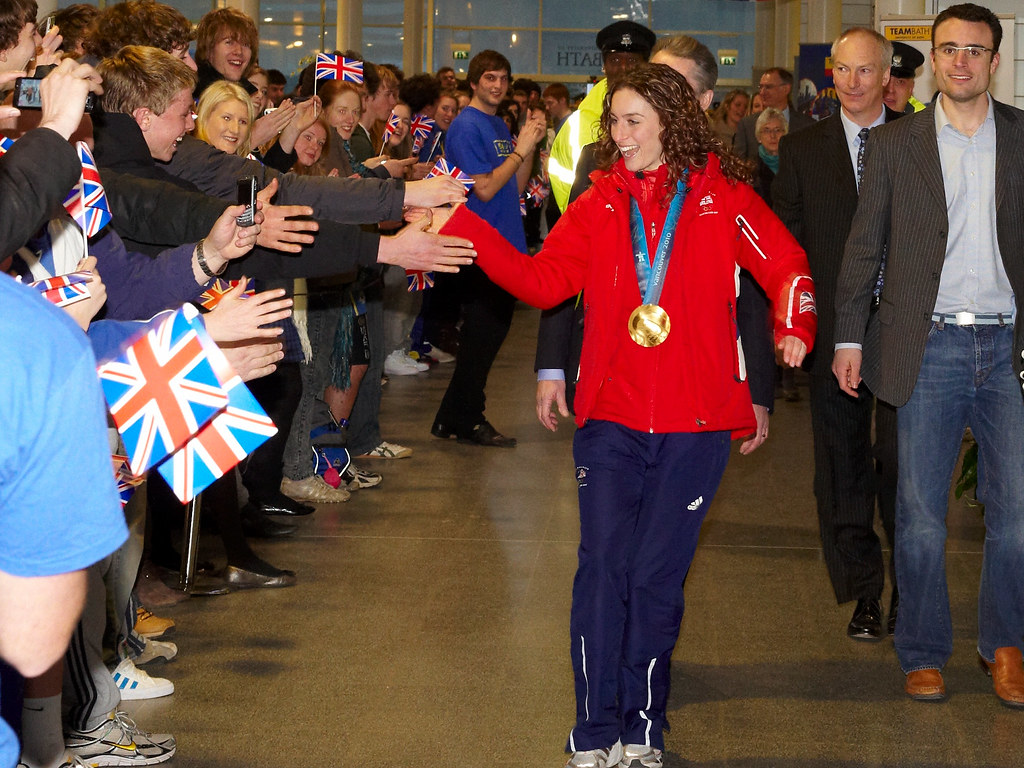
In the two decades since, Skeleton’s Bath-based winter Olympians have gone on to achieve world-beating performances at successive Winter Olympic Games, totalling seven medals since 2002 and winning 50% of the available medals at the PyeongChang Olympics in 2018.
For the winter sport where athletes launch themselves head-first, face down on a sled to race at speeds of up to 90 miles per hour down an ice track, Alex Coomber was the first athlete to taste medal success, taking bronze at Salt Lake City (2002). Next came Shelley Rudman, who claimed silver in Torino (2006), before University graduate (now also Honorary Graduate), Amy Williams, made history with a stunning gold in Vancouver (2010).
Amy’s victory was followed by a golden double for Lizzy Yarnold, who not only took the crown in Sochi (2014), but four years later successfully defended her title at PyeongChang (2018), alongside teammates Laura Deas and Dom Parsons (a PhD student at the time) both claiming bronze.
As this year’s Winter Olympics skeleton competition gets underway in Beijing from 10 – 12 February, followed by the bobsleigh from 13 – 20 February, all eyes will be on the British team and the athletes who train at Bath.
From sports science to performance
Behind the scenes though is an equally impressive story of research and innovation as British Skeleton seeks to evolve and retain its level of success. The last decade has seen a strong relationship develop between British Skeleton and sports scientists based in the University’s Department for Health and (CAMERA) to help underpin coaching processes.
started her research career just over a decade ago, working with British Skeleton’s (then head of Start Performance and now Head of Innovation and Applied Research) as part of her PhD in the lead up to the Sochi 2014 Games. Her work focused on adding strength and data to what was then a programme based on experience and subjective coaching opinion and direction. Coaches have been helped to support athletes achieve gains at the start of their run as a result, something which can make the difference between gaining a place on the podium or not.
As she explains: “Although the major championships are decided across four runs, which usually equates to around 4 minutes of sliding, the difference between gold and silver, or ending up on or off the podium can be a matter of milliseconds. In the past we’ve seen winning margins attributed to differences at the start – including Lizzy’s gold-winning margin in Sochi – and so British Skeleton has put much emphasis into enhancing this part of the race.
“The start provides the only opportunity for athletes to accelerate the sled (above acceleration due to gravity) and from there it comes down to how best you can minimise energy losses by driving the sled well. Getting the highest velocity possible at the start is often vital to a successful run.”
Utilising advanced motion capture
Much of Dr Colyer and her colleagues’ work has sought to answer questions posed by the sports coaches - and particularly Holdcroft - with a focus on learning lessons from science research into the sprint start in athletics, and to apply this to the ice.
Some of the latest EPSRC-funded research draws on computer science expertise from CAMERA in which British Skeleton is a key partner and has resulted in the development of a non-invasive markerless motion capture technology to help coaches accurately measure athletes’ push start performances.
As part of this research, the Bath team used a set-up of nine cameras along both sides of the push-track, creating a markerless system, and compared measurements with those obtained via conventional methods allowing the researchers to capture athlete data “in the wild”, says collaborator from CAMERA who developed the technology with .
As Laurie explains: “The non-invasive nature of this approach means that we can capture important push-start information without interfering with the athlete’s training session. Our AI-driven technology allows for fully automated data processing and information is shared with coaches via a cloud-based web application.”
For Steffi Colyer this approach has huge potential for future sports biomechanics: “Conventional ‘marker-based’ technologies, which we use every day in our laboratory research, are not feasible in many elite sports training and competition environments, so the future of sports biomechanics likely lies in finding accurate and unobtrusive markerless solutions. Our system can provide information about British skeleton athletes’ start performances that was previously inaccessible to the coaches.”
.
Long-term collaboration
Building on this work, British Skeleton part-funded and committed to embedding University PhD student, , fully into their performance programme. This project is now using CAMERA’s markerless technologies to further enhance the sport’s knowledge of the skeleton push-start, with a focus on medal potential in both Milano Cortina 2026 and the yet to be decided 2030 Olympic Games.
The collaboration with British Skeleton and with athletes based on campus is helping to generate real impacts in terms of Bath’s sports science research. “Such a long-standing relationship is quite rare in research and has allowed us to truly understand British Skeleton’s needs and how we can help them to achieve their goals”, says Dr Colyer.
“The combination of facilities and research expertise at Bath is unique, but that wouldn’t be enough without the positive relationship that both sides have invested into over the years. Having a real understanding of each other’s goals and needs is something that doesn’t come without investment of time and effort from both parties. We continue to be grateful for British Skeleton’s enthusiasm towards our projects and the shared vision we have.”
For British Skeleton this feeling is mutual. As Danny Holdcroft, Head of Performance Innovation and Applied Research at the British Bobsleigh and Skeleton Association, says: “Our continuing relationship with the ºÃɫtv is something that we hold in high regard and value greatly as we seek to support our athlete aspirations of winning Olympic Gold Medals in 2022, 2026 and 2030. The CAMERA project is an exciting piece of our larger jigsaw and will undoubtedly help us further explore beyond our current performance boundaries.”